|
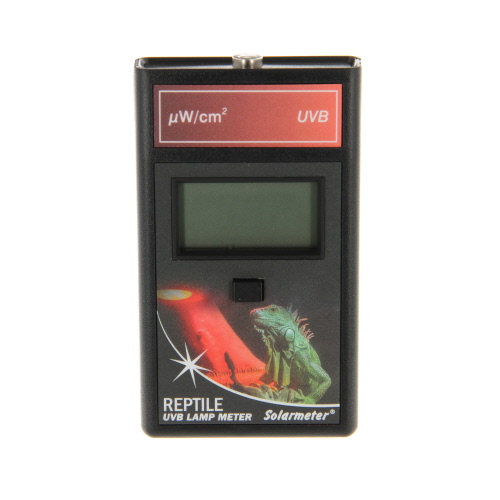
This compact Digital UVB Meter is the perfect tool for measuring UVB Ultraviolet Light.
Suited for testing the UVB level of reptile lamps, UVB lamp intensity & and their performance over time, UV Block comparison and many other applications where levels of UVB light are critical.

 Integral Sensor Integral Sensor
Compact
Durable
Accurate
LCD readout

Lamp UVB Intensity & Aging
Reptile Lamps
Acrylic Shield Transmission
Percent (%) UVB if divided by reading from Model 5.7 (UVA + B)
Eyewear UV block comparison

Detector Data
|
| Model |
6.2 |
| Irrad. Range |
0 - 1999 µW/cm² UVB |
| Response |
280-320 nm |
| Resolution |
1 µW/cm² |
| Conversion Rate |
3.0 Readings/Sec |
| Lens |
UV Glass |
| Diffuser |
Virgin Teflon .033" |
| Accuracy |
±10% REF NIST |
| Display |
| Type |
3.5 Digit LCD |
| Digit Size |
10mm |
| Environmental data |
| Operating temperature range |
+0°C to +32°C |
| Operating Humidity |
5% to 80% RH |
| Physical characteristics |
| Size, L x W x H |
105 x 6- x 20mm |
| Weight |
110g |
| Power Source |
| Battery |
9V PP3 Battery |
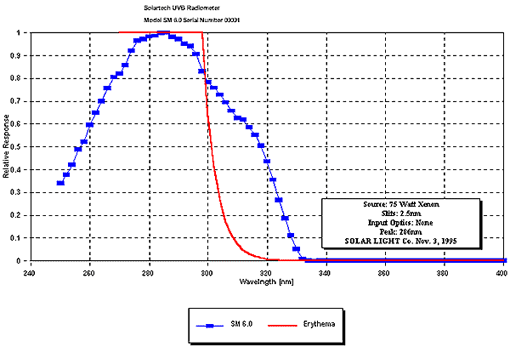
Proper Usage of Solarmeter ® Ultraviolet Radiometer for Lamp Aging Tests
Wear eye protection when checking UV lamps (UV-block wrap around glasses).
Allow lamps to warm-up prior to taking readings (at least 5 min).
When checking aging of lamps, keep measuring distance and locations constant.
Lamps should be replaced when output drops 30% to about 70% of their original (new) readings. Take overall reading at exposure distance, or check individual lamps close to surface. Keep track of hours vs. readings on a chart.
If unsure of what original new values were, replace lamp(s) with new ones of the same kind and compare to old ones.
To determine percent UVB divide Model 6.2 reading by Model 5.7 total UV (UVA + B) reading.
When checking UVT acrylic transmission, take reading through acrylic; then remove acrylic and hold meter sensor at approximately the same distance from lamp as the acrylic shield was located. If acrylic blocks much UVB it should be replaced.
When using this meter to compare different type lamps, due to their different spectral power distributions, the readings should be considered relative rather than absolute. Although higher output lamps of similar SPD's will generally read higher than lower output lamps, ones that peak near 290-300 nm (as does the meter response) will read higher than ones peaking near 313 nm even if the total UVB output of both is the same.
Do not subject the meter to extremes in temperature, humidity, shock or dust.
Use a dry, soft cloth to clean the intrument. Keep sensor free of oil, dirt, etc.

 1no: Solarmeter® 6.2 UV Meter 1no: Solarmeter® 6.2 UV Meter
1no: Manufacturers Calibration Certificate
1no: Leather Protective CaseBattery(2 x AAA)
1no: 9V PP3 Battery
1no: Instruction Sheet
1no: 12 Month Warranty
|